
Blog
Football Shirt Numbers Explained: What Squad Numbers 1-11 Mean

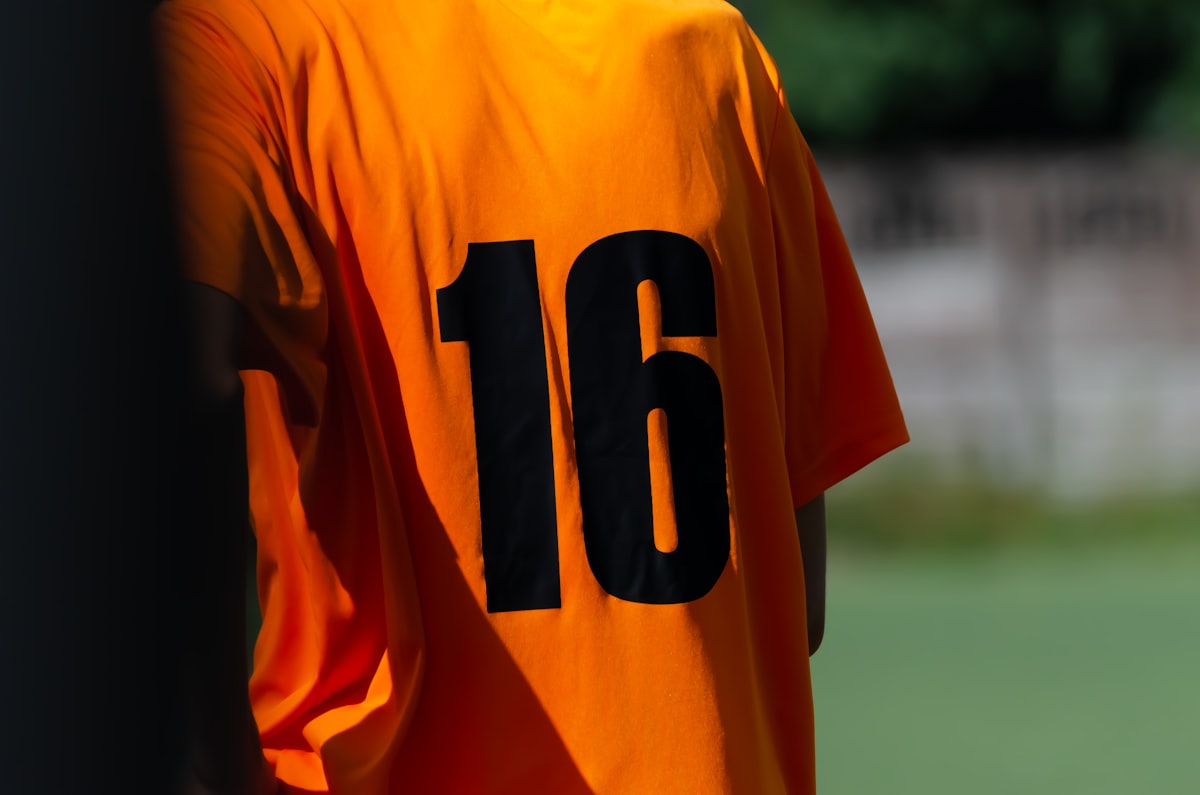
Football shirt numbers 1 to 11 originally described positions, not players. The system was set on 25 August 1928 by Chelsea and Sheffield Wednesday and reflected the 2-3-5 formation: 1 in goal, 2 and 3 at full back, 4 to 6 at half back, 7 to 11 in the forward line.
Football shirt numbers began as a way to tell players apart, not as a badge of identity. The 1–11 system mapped onto a formation that no longer exists, yet the meanings stuck — and today’s squad numbers still borrow their weight from it. Here is where each number came from, what it signals now, and which rules actually govern what a player can wear.
What do football shirt numbers 1 to 11 mean?
Numbers 1 to 11 originally described positions on the pitch, not individual players. On 25 August 1928, Chelsea and Sheffield Wednesday each ran out in numbered shirts, and the mapping they used became the template: 1 in goal, 2 and 3 at full back, 4 to 6 across the half-back line, and 7 to 11 in the forward line.
Those slots reflect the 2-3-5 formation of the era, which fielded five forwards and only two defenders. Because no modern side plays 2-3-5, the 1928 mapping no longer describes what a player actually does. The associations below are conventions that grew up around the numbers, not rules — a club is free to ignore every one of them.
| Number | Position in the 1928 mapping | Commonly associated with today |
|---|---|---|
| 1 | Goalkeeper | First-choice goalkeeper |
| 2 | Right full back | Right back |
| 3 | Left full back | Left back |
| 4 | Right half back | Central midfield or central defence |
| 5 | Centre half back | Centre back |
| 6 | Left half back | Central midfield or central defence |
| 7 | Right forward | Wide attacker |
| 8 | Inside right forward | Central midfield |
| 9 | Centre forward | Centre forward |
| 10 | Inside left forward | Attacking midfield or forward |
| 11 | Left forward | Wide attacker |
When did clubs stop using 1 to 11 every match?
English football moved to permanent squad numbers in 1993. Until then the shirt described the role, so the same player could wear 6 one week and 4 the next depending on where he started.
The Football Association dropped compulsory 1–11 numbering that year, and the 1993 Football League Cup final between Arsenal and Sheffield Wednesday was played with persistent squad numbers. The Premier League adopted them from the following season, and most of Europe followed during the 1990s. Before all this, numbering had been optional: the Football League only made it compulsory for the 1939–40 season, and the earliest recorded use of numbered shirts anywhere dates to 1911 in Australia, with the first documented English instance at Stamford Bridge on 23 March 1914.
International football settled the question earlier. The 1950 World Cup was the first to use squad numbers, and from the 1954 tournament each player kept a fixed number for the whole competition.
Can a player wear any number?
Almost. Squad numbers generally run from 1 to 99 and must be unique within a squad, which is why a new signing cannot always take the number he wore at his previous club.
The goalkeeper rule
The main restriction concerns the goalkeeper. In July 2007 FIFA ruled that the number 1 shirt must be issued to a goalkeeper in its competitions, ending exceptions such as the alphabetical numbering Argentina had used, which could place an outfield player in the 1 shirt. Second-choice goalkeepers conventionally take 12 or 13.
Federation-specific bans
Individual federations occasionally add their own restrictions. The Italian federation prohibited the number 88 in 2023 over its antisemitic connotations.
Why is the number 10 shirt so important?
The 10 carries its status from the players who have worn it rather than from any rule. It began as the inside-left forward slot in the 1928 mapping, and it has since become the number historically associated with elite playmakers and forwards — Lionel Messi being the most cited modern example.
That matters before you order a printed shirt, because the number you choose reads as a statement about the position as much as the player. If you are picking a name and number for the back, our guide to football shirt personalisation covers font rules, league-specific printing and what can and cannot be applied.
How do I find out what number a specific player wears?
Check the club’s official squad list, which is confirmed before each season. Numbers change whenever a player transfers or a number is freed up, so a list published in May may already be out of date by August.
We publish full club lists — for example Liverpool’s 2026/27 squad numbers and Real Madrid’s 2026/27 squad numbers — plus individual pages for new signings whose numbers are still being decided.
International squads are numbered separately from clubs, so a player can carry one number for his country and a different one for his club. You can browse the 2026 World Cup national team shirts or the Premier League club shirts to see the current season’s kits before adding printing.
Do numbers differ between fan and player shirts?
The number itself is identical — same digit, same official league typeface. What can differ is how it is applied to the fabric, and that varies by kit and manufacturer rather than following one fixed rule.
Our comparison of player version versus fan version shirts sets out where the two tiers actually diverge, including cut, fabric and finishing. If you are unsure which size to order, start with the football shirt sizing guide.
Numbering style is also part of what makes older kits collectable. Browse retro shirts to compare the numerals of past decades against the current designs.
Historical dates in this guide are drawn from Wikipedia’s record of squad numbering in association football.




 Premier League
 La Liga


















 Serie A

















 Bundesliga





















 Liga MX







 Liga Portugal






 Ligue 1










 Kings League









 Brasileiro Serie A
























 MLS
MLS













 Other Leagues